If you’ve ever searched for answers about acne online, you’ve probably come away feeling more confused than when you started.
One article tells you to stop eating dairy. Another blames sugar. Someone else insists your acne is caused by an unhealthy gut, while another claims diet has nothing to do with it at all.
So, who’s right?
The answer isn’t as simple as choosing one side.
Acne is one of the most common skin conditions worldwide, yet it’s also one of the most misunderstood. It’s influenced by a combination of genetics, hormones, oil production, inflammation, bacteria and the way our skin naturally sheds its cells.
Increasingly, research suggests that nutrition and gut health may also play a role for some people.
That doesn’t mean changing your diet will cure acne.
Nor does it mean food has no influence whatsoever.
The reality lies somewhere in between.
At Indiahna Sage, we believe healthy skin is best understood by looking at the bigger picture. Rather than searching for one cause or one miracle solution, we consider how multiple factors interact to influence skin health—including nutrition, lifestyle, skin barrier function and overall wellbeing.
Let’s start by understanding what people mean when they talk about the “gut–skin connection.”
Understanding the gut–skin connection
Inside your digestive system lives a vast community of microorganisms known as the gut microbiome.
These microorganisms help with much more than digestion.
They contribute to immune function, help maintain the gut lining and produce compounds that support normal body processes.
Researchers now understand that the gut and the skin communicate through a network often referred to as the gut–skin axis.
Because the gut plays an important role in regulating immune responses, scientists are exploring how changes within the gut microbiome may influence inflammation elsewhere in the body—including the skin.
This doesn’t mean everyone with acne has poor gut health.
Nor does it mean improving your gut microbiome will automatically clear your skin.
Instead, it highlights something much more important:
Your skin doesn’t function in isolation.
It’s influenced by many systems working together.
Clinician’s Insight
Healthy skin isn’t simply about what you apply to the surface. Your skin reflects the interaction between genetics, hormones, immune function, nutrition, lifestyle and the environment. Looking at the bigger picture often provides more meaningful answers than focusing on a single cause.
Acne is more complex than one food
One of the biggest misconceptions surrounding acne is that it’s caused by eating the “wrong” food.
Current evidence doesn’t support this.
Acne develops when several biological processes occur together, including:
- Increased oil production
- Changes in skin cell turnover
- Inflammation
- Growth of Cutibacterium acnes
- Hormonal influences
- Genetic predisposition
Because there are so many contributing factors, it’s unlikely that one food alone explains why someone develops acne.
Instead of asking:
“What food is causing my acne?”
A more helpful question is:
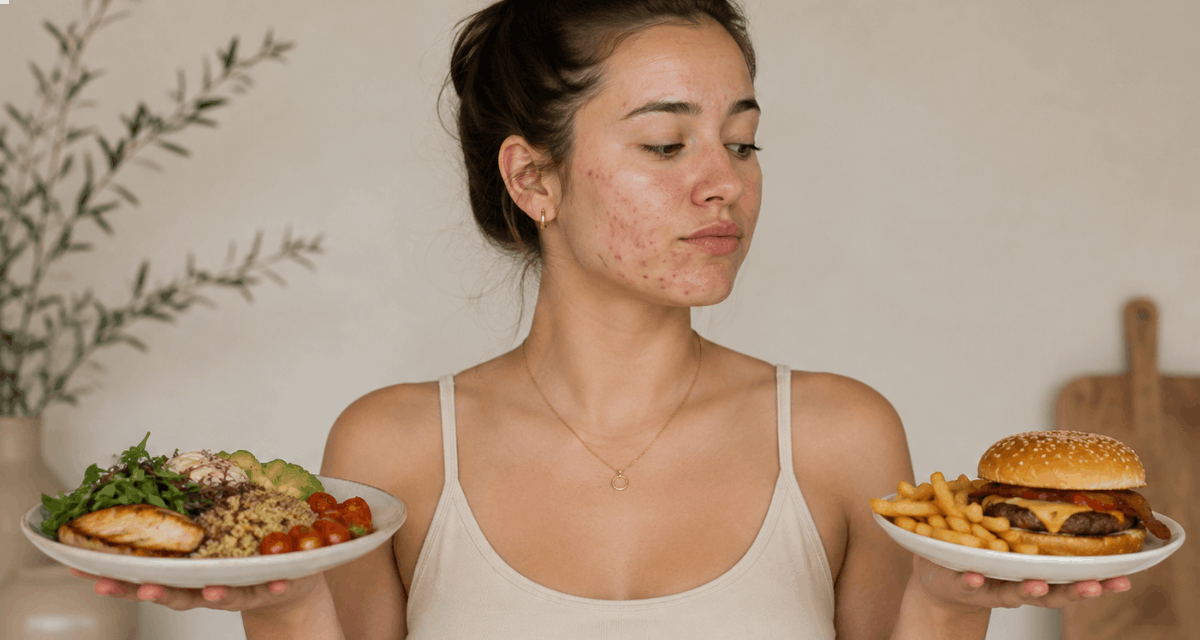
“Could my overall dietary pattern be influencing the environment that allows acne to develop?”
For some people, the answer appears to be yes.
For others, diet may have very little influence.
This is why personalised advice is so important.
What does the research actually say?
Research into nutrition and acne has grown significantly over the past two decades.
While scientists are still learning about the relationship between diet and skin, there are a few areas where evidence is becoming stronger.
High glycaemic diets
Dietary patterns high in refined carbohydrates and sugary foods may contribute to acne in some individuals.
These foods can increase insulin and insulin-like growth factor-1 (IGF-1), which influence several biological processes involved in acne development, including oil production and skin cell turnover.
Rather than avoiding carbohydrates altogether, current evidence supports choosing minimally processed, fibre-rich carbohydrate sources more often than refined alternatives.
Dairy
Some studies have found an association between certain dairy products—particularly skim milk—and acne.
However, this doesn’t mean dairy causes acne for everyone.
Many people consume dairy without any effect on their skin.
At this stage, there isn’t enough evidence to recommend removing dairy unless there’s a genuine reason to do so.
If you’re considering eliminating a food group, it’s important to ensure your overall nutritional intake remains balanced.
Building an acne-supportive way of eating
One of the most common things we hear is:
“I’ve stopped eating dairy, gluten, sugar and chocolate… but my skin still hasn’t improved.”
Often, clients feel exhausted from trying to eat “perfectly.”
Instead of asking what you should remove from your diet, consider what you can add.
Small, consistent improvements are usually more sustainable than restrictive eating patterns.
One of the simplest ways to support overall health is by increasing the variety of whole foods you eat throughout the week.
Colourful vegetables, fruit, legumes, whole grains, nuts and seeds all contribute valuable nutrients, fibre and phytonutrients that support normal body function.
While no individual food will “clear” acne, a dietary pattern rich in minimally processed foods provides your body with many of the nutrients needed to maintain healthy skin.
Why colourful foods matter
One of the simplest ways to improve the nutritional quality of your diet is to eat more colour.
Fruit, vegetables, herbs and spices are naturally rich in phytonutrients bioactive compounds that help protect plants from environmental stress. These compounds are also being studied for the ways they support human health, particularly through their antioxidant and anti-inflammatory properties.
Because acne is an inflammatory skin condition, a diet rich in a variety of plant foods may help support the body’s normal inflammatory processes and overall skin health.
Rather than searching for one “superfood”, aim for diversity.
Think about adding more:
- 🥬 Dark leafy greens
- 🍅 Tomatoes
- 🥕 Carrots and pumpkin
- 🫐 Berries
- 🥦 Broccoli
- 🫑 Capsicum
- 🍊 Citrus fruits
- 🫘 Legumes
- 🌰 Nuts and seeds
Every colour contributes a different combination of vitamins, minerals and phytonutrients, making variety more valuable than focusing on any one food.
Fibre: a nutrient your gut loves
Fibre is often associated with digestive health, but its benefits extend well beyond regular bowel habits.
Many types of fibre act as food for the beneficial bacteria living in your gut. As these bacteria ferment fibre, they produce compounds that help support the gut lining, immune function and healthy inflammatory responses.
Good sources of fibre include:
- Vegetables
- Fruit
- Whole grains
- Oats
- Lentils
- Chickpeas
- Beans
- Nuts
- Seeds
Rather than trying to overhaul your diet overnight, look for simple opportunities to include one extra source of fibre each day.
Small changes are often the easiest to maintain.
Diversity is more important than perfection
One of the most exciting discoveries in microbiome research is the importance of diversity.
A healthy gut microbiome isn’t built by eating one “perfect” food. It’s supported by regularly eating a wide variety of plant foods.
A practical goal that’s becoming increasingly popular is aiming for around 30 different plant foods across the week.
That includes:
- Vegetables
- Fruit
- Whole grains
- Legumes
- Herbs
- Spices
- Nuts
- Seeds
It may sound like a lot at first, but every ingredient counts—even fresh herbs sprinkled over dinner or cinnamon added to your morning oats.
The goal isn’t perfection.
It’s variety and consistency over time.
Quick Take
If you’re wondering where to start, don’t focus on what to remove. Focus on adding more variety to your meals. Your gut—and the rest of your body—will benefit from the diversity.
Looking beyond food
Although nutrition is an important part of the conversation, it’s only one piece of the puzzle.
Acne can also be influenced by:
- Hormonal changes
- Genetics
- Stress
- Sleep
- Skin barrier function
- Skincare products
- Certain medications
- Environmental factors
This is why we take an integrative approach at Indiahna Sage.
Rather than looking at nutrition in isolation, we consider how these factors interact to influence your skin.
Sometimes nutrition is a significant contributor.
Sometimes it’s only a small piece of a much larger picture.
Understanding that difference helps us create personalised treatment plans instead of relying on one-size-fits-all advice.
Five Things to Remember
✓ Acne is a complex condition with many contributing factors.
✓ Your gut microbiome may influence skin health through its role in immune function and inflammation.
✓ Current evidence suggests some dietary patterns—not individual foods—may contribute to acne in certain people.
✓ A varied, minimally processed diet rich in colourful plant foods and fibre supports overall health and may also benefit your skin.
✓ Lasting skin health comes from consistent habits, not restrictive diets or quick fixes.
Frequently Asked Questions
Should I cut out dairy if I have acne?
Not necessarily. Some people notice an improvement when they reduce certain dairy products, while others don’t. Current evidence doesn’t support eliminating dairy for everyone with acne.
Is sugar causing my breakouts?
Sugar itself hasn’t been proven to cause acne, but dietary patterns high in refined carbohydrates may contribute to acne in some people.
Do I need to take probiotics?
Not always. While probiotics are an exciting area of research, there’s currently no single probiotic recommended as a universal treatment for acne. For most people, focusing on a varied, fibre-rich diet is a practical place to begin.
Is there an acne diet?
No. There is no universal diet that has been shown to clear acne in everyone. The strongest evidence supports an overall dietary pattern rich in whole foods rather than restrictive eating.
What’s the most important nutritional change I can make?
If you’re looking for one place to start, increase the variety of plant foods you eat each week. This simple habit supports overall nutrition, dietary diversity and gut health.
Our Perspective
At Indiahna Sage, we don’t believe in blaming individual foods or promoting restrictive diets.
Healthy skin is influenced by many factors, and nutrition is just one piece of a much bigger picture.
Our role is to help you understand how those pieces fit together so you can make informed decisions that support your skin over the long term.
Rather than chasing trends or searching for quick fixes, we focus on building sustainable habits grounded in current evidence and tailored to the individual.
Because healthy skin isn’t built through perfection.
It’s built through understanding.
Further Reading
This article is based on current evidence relating to nutrition, the gut microbiome and acne. As new research emerges, our educational resources are reviewed and updated to reflect the latest evidence.
References
- American Academy of Dermatology. Guidelines of care for the management of acne vulgaris.
- Dermatology and Therapy. Diet and Acne: An Update on the Evidence.
- Journal of the Academy of Nutrition and Dietetics. Nutrition and Acne: A Systematic Review.
- Skin Nutrition Institute. Functional Skin Nutrition & Nutridermatology educational resources.
- Australasian College of Dermatologists. Acne and healthy skin resources.